Commerce-aware AI · Shopify support
AI support forShopify brands thatresolves ticketswithout leaking money.
Zelpher reads the ticket, order, customer history, policy, and risk before it drafts, escalates, refunds, replaces, or resolves.
Shopify-first · Human approval for money-moving actions · Full decision trail
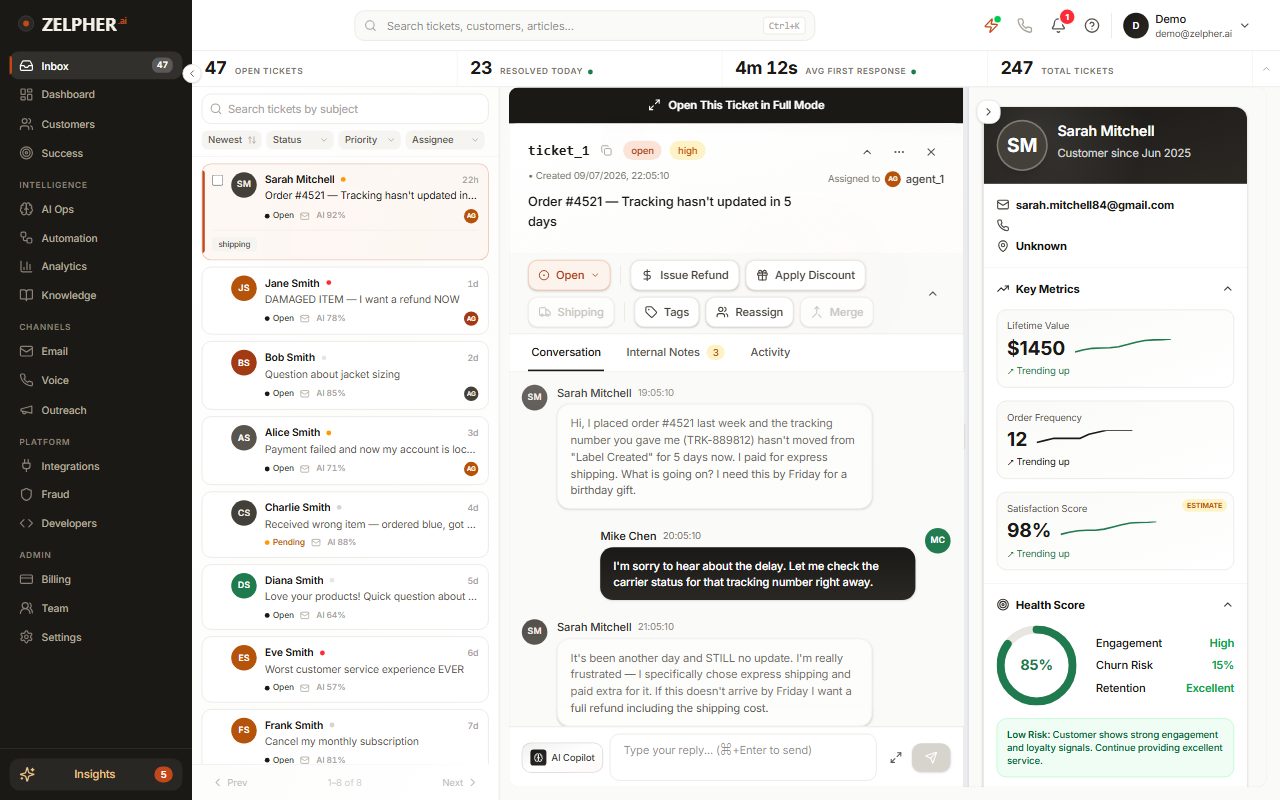
Live product demo: Sarah Mitchell reports order #4521 stuck in transit. zelpher reads the thread and drafts a $42.00 refund (shipping $30.00 plus $12.00 goodwill). The policy check finds no auto-approve rule, so the refund waits for human approval; Mike Chen approves it within the $500 cap, the refund is logged to the audit trail, and her sentiment recovers from −70 to +50.
Live product walkthrough · demo data, real workflow
We’ll replace these with measured numbers — labelled as measured — once founding merchants are live.
Live interactive demo
One ticket, start to finish.
Sarah’s wool throw is stuck in transit. Watch Zelpher read the thread, check the policy, propose a $42 refund — and wait for a human before a cent moves.
- Policy checked before any draft
- Money waits here for a human
- Every decision written to the audit log
The real product on demo data — click to try it yourself.
The decision layer
Zelpher is the system in the middle of your support stack.
Tickets, orders, policies, customer history, and tracking flow into one decision layer — so every reply, refund, escalation, and audit trail has context, and every money-moving action waits for a human. Below, it runs Sarah’s ticket #4521 — the same one from the demo.
Built different from a helpdesk.
Zelpher isn't a faster inbox — it's a different architecture. Every step of the support workflow gets context, policy, and a human-gated money action, not just an AI suggestion.
Early is our biggest weakness. Founding merchants get to shape what we build next.
Join the waitlistHow a ticket moves through Zelpher.
Five stages. The first four are automatic. The fifth is yours whenever money or policy is involved — it expands into the eight-step money path you’ll meet in Guardrails.
Read
Every inbound message is parsed for intent, order references, and sentiment.
Contextualize
Zelpher pulls the Shopify order, tracking status, customer history, and lifetime value into one working memory.
Decide
The Decision Engine matches the situation against your policies and proposes an action with a confidence score.
Draft
A reply is written in your brand voice, citing the real order and the real fix.
Gate & act
Actions inside the rules you wrote can run automatically. Anything touching money or outside policy waits for one-click human approval. Everything is logged.
This wire doesn’t exist in Zelpher.
AI proposes. A human approves every money move.
Guardrails
Built to move fast without moving money recklessly.
Zelpher drafts and triages quickly. But refunds, discounts, credits, fraud holds, and any other money-moving action stay behind policy checks, budget limits, and human approval — the same eight stages Sarah’s $42 refund passed in the demo.
- 01LLM
- 02Schema
- 03Policy
- 04Budget
- 05Human approval
- 06Executor
- 07Reconcile
- 08Audit
What the demo proves
Proof you can watch, not logos we borrowed.
Policy before action
A refund recommendation cannot become execution until policy and approval are present.
Evidence before confidence
The AI shows the order, tracking, history, and policy behind every recommendation.
Approval before money
Financial actions wait for a human — money-moving actions require explicit approval.
Audit after every decision
Approvals, rejections, and execution results are logged with evidence, actor, and outcome.
Shopify-first context
Reads the Shopify order, customer, fulfillment, refund, and policy behind every ticket.
Fail-safe operation
If context or the AI is unavailable, Zelpher degrades to suggestion-only.
Customer stories will replace this once founding merchants are live.
Pricing that's set before launch.
We haven't finalized tiers. We have finalized the promises.
Founder pricing, for life
Waitlist members who onboard in the first cohort keep their launch price for as long as they stay.
Priced per resolution, not per seat
You pay when zelpher resolves work, not for the number of humans watching it.
A cap you set
Monthly spend cap in-product. When you hit it, zelpher asks before continuing. No surprise overage invoices.
Public pricing at launch
The full price list goes on this page the day we open. No "contact sales" wall.
Joining the waitlist locks in founding-cohort eligibility. No card required.
Fair questions.
No — not by default, and only ever inside rules you wrote. Out of the box, every refund waits for one-click human approval; Zelpher recommends with evidence, but money moves only after a policy check and your click. If you later set a rule — say, “auto-approve shipping refunds under $50 for customers with 5+ orders” — it acts inside that rule and logs every action. You can tighten or revoke any rule at any time.
You shouldn't trust claims — that's why we don't make measured ones. Every number on this page is labelled as a design target, every screenshot is captured from the running product, and the comparison table concedes where incumbents beat us. Judge the mechanism, not the marketing.
When unsure, it defaults to no action: low-confidence or missing-context cases become suggestions for a human, never silent execution. When wrong, three layers contain it: confidence thresholds route uncertain tickets to humans, money-touching actions default to approval, and the audit log records exactly what the AI saw and proposed — so you can correct the policy, not just the ticket.
It replaces the repetitive tickets, not the team. Your agents handle the conversations that need judgment and empathy while Zelpher clears the “where is my order” queue — and it is a full commerce-aware helpdesk on its own (queue, threads, notes, customer profile, order history, approvals, audit), so nothing gets bolted on. Headcount decisions stay yours.
Customer data stays scoped to your store, is encrypted in transit and at rest, and is never used to train models for other merchants. We are pre-launch and not yet independently audited; a SOC 2 Type I audit is on our launch-year roadmap, and we'll publish the report when it exists — not a badge before it.
Shopify only, on purpose. Depth on one platform — orders, refunds, tracking, customer history, policy — beats a shallow integration with ten. Email support first; more channels and platforms come after resolution quality proves out.
Yes. Policy caps, budget limits, and escalation rules are yours to set; anything over the cap is blocked and escalated — even if a human tries to approve it. You can feel this in the demo above: set a $25 cap and watch your own rule stop the $42 refund.
Zelpher degrades safely to suggestion-only — it will not take money-moving actions without live context and approval.
A note from the founder.
I've run Shopify stores. I've packed orders on the kitchen table and answered "where is my order?" for the hundredth time at 11pm, knowing a $12 shipping refund would fix it — and that the tools wanted me to click through four screens to do it.
Every AI support tool I tried made the same trade: either it did nothing useful, or I had to hand it my refund button and hope. I refused that trade, so I'm building the third option — software that works like a great support lead. It handles the routine completely, brings you the judgment calls, and never spends your money on a vibe.
We're pre-launch. That means what you see here is the actual product and our actual targets, not case studies we don't have. If you run a Shopify store and this resonates, join the waitlist — and email me what would make you trust an AI with your inbox. I read all of it.
— Jonny, founder, zelpher.ai

Your inbox runs itself — until money moves.
Join the waitlist for the founding cohort: lifetime founder pricing, direct access to the founder, and a say in what ships first.
No spam, no card. One email when we open, and the occasional build update you can opt out of.